Engine Replacement Cost UK: Why Automatic Cars Can Cost More Than Manuals
The Short Answer
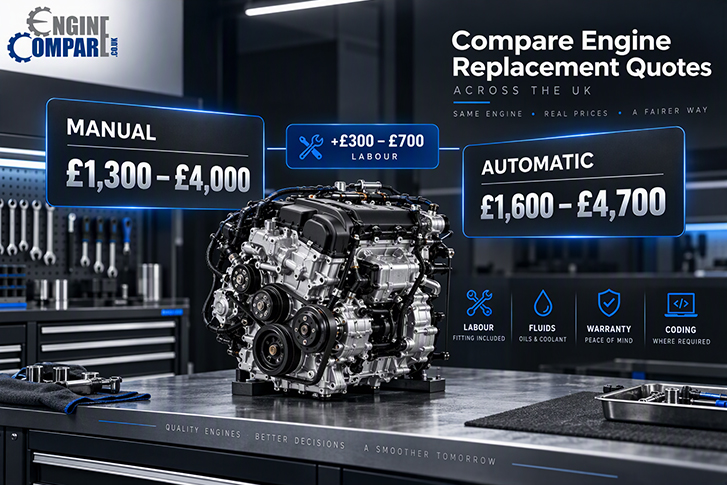
An automatic engine replacement usually costs £300–£700 more than the same job in a manual car because the gearbox is heavier, the torque converter must be separated and refitted correctly, and the transmission cooling system needs careful handling. On some models, the difference in engine fitting cost is larger, particularly where the gearbox has to come out with the engine. Comparing several engine replacement quotes can help you see whether labour, fluids and essential ancillary parts are included.
What changes between manual and automatic?
| Factor | Manual | Automatic |
| Gearbox weight | Lighter | Heavier |
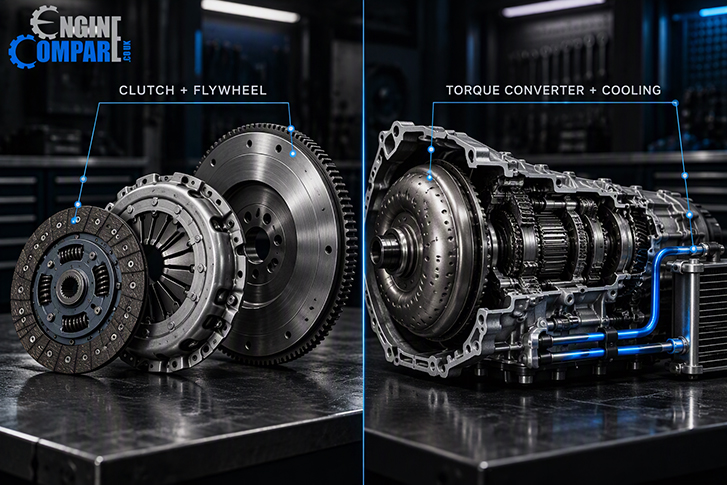
| Separation method | Clutch and flywheel | Torque converter and flexplate |
| Fluid management | None | Transmission fluid and cooler lines |
| Additional risk | Clutch wear | Converter seal and cooling |
| Typical labour uplift | Baseline | +£300–£700 |
| Best practice | New clutch at high miles | Fluid and filter service |
Why the labour differs
The gearbox itself is heavier, which changes how it is supported and moved during a replacement engine fitting. The torque converter must be seated correctly on the pump drive; if it is not, the transmission can fail shortly after the engine starts. Cooling lines are disturbed and must be refilled and bled. None of this is unusually difficult for an experienced engine fitting specialist, but every additional step increase labour time and the final fitted price.
What should be renewed at the same time?
- Clutch, release bearing and flywheel on a manual at high mileage.
- Transmission fluid and filter on an automatic.
- Engine mounts and gearbox mount if worn.
- Coolant, oil, filters and gaskets.
- Seals between engine and gearbox.
What are the risks specific to automatics?
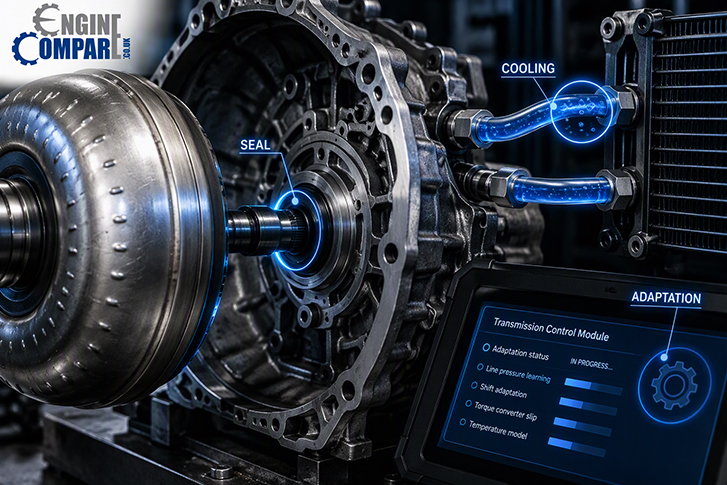
The torque converter seal, the cooling circuit and the electronic adaptations. A converter not fully seated damages the pump immediately; a cooling circuit with air in it overheats the transmission on the first drive; and adaptations must be reset after major work so the gearbox relearns.
How does the quote differ?
| Route | Manual fitted | Automatic fitted |
| Used engine | £1,300–£2,400 | £1,600–£3,000 |
| Reconditioned engine | £2,400–£4,000 | £2,900–£4,700 |
| With clutch or fluid service | +£350–£900 | +£250–£450 |
What should you ask before booking?
- Whether the gearbox comes out with the engine.
- Whether the clutch or transmission fluid service is included.
- Whether adaptations are reset on an automatic.
- What warranty covers the gearbox interface.
- The firm collection date.
Should you service the gearbox during an engine swap?
Yes, if it is due or overdue. On an automatic, an engine out is a convenient moment to replace transmission fluid and filter, and on a manual at high mileage a clutch and flywheel makes sense. Both are cheaper now than as separate jobs later.
How do you compare manual and automatic quotes?
Compare quotes only within the same transmission type because manual and automatic swaps are different jobs. Ask each used engine replacement specialist for a like-for-like breakdown covering the engine, labour, fluids, ancillaries, coding and warranty. If you own an automatic, check whether converter seals, cooling lines and gearbox adaptations are included; these details separate a professional supply and fit engine quote from a low headline price that may rise later.
Frequently asked questions
Is an engine swap harder in an automatic car?
Not harder, but longer, and it carries additional risks around the torque converter and cooling circuit.
How much more does an automatic swap cost?
Typically £300–£700 more in labour, plus fluid and filter costs where a service is included.
Can I fit a manual engine into an automatic car?
Only with matching ancillaries and software, and the job is rarely economic. Match the code and the transmission the car was built with.
Should I replace the clutch during a manual engine swap?
At above 100,000 miles, yes. The labour is already being paid and the parts are modest.
Do automatics need adaptations after an engine swap?
Yes, in most cases, and a workshop without the equipment to do it is not equipped for the job.
What does an automatic swap include that a manual one does not?
Converter seal renewal, cooling line refilling and bleeding, transmission fluid and filter where the service is due, and adaptation reset so the gearbox relearns its shift values. On a professional quote those items are listed; on a cheap quote they are absent, and their absence is what turns a straightforward job into a return visit.
What does the labour breakdown look like on an automatic?
| Stage | Manual | Automatic |
| Strip and disconnect | 3–4 hours | 3–4 hours |
| Remove engine and gearbox | 3–5 hours | 4–6 hours |
| Transfer ancillaries | 3–5 hours | 3–5 hours |
| Refit with converter and cooling | 3–5 hours | 5–7 hours |
| Code, adapt and road test | 1–2 hours | 2–3 hours |
Add roughly a day of skilled labour for an automatic, which at typical independent rates explains the £300–£700 difference in most quotes.
What is the one-line answer on manual versus automatic swaps?
The job is longer and riskier on an automatic, costing £300–£700 more in labour, so ask what the quote includes for converter seals, cooling lines and adaptations.
What should you ask when the car is an automatic and the quote looks high?
Ask for the labour breakdown. On an automatic, the additional hours should appear as separate lines for gearbox removal, converter handling, cooling circuit refill and adaptation. When those lines are visible, the higher price makes sense; when they are absent and the price is still high, ask what the extra money is for.
Does the transmission type affect the warranty?
Yes, and it is worth checking before choosing a replacement engine with warranty. An engine-only warranty does not normally cover the gearbox, so if the converter seal fails after the job, responsibility may be disputed. With a single company handling the reconditioned engine supply and fitting, the scope of cover is usually clearer.
Always confirm the warranty term, including parts, labour cover and claim conditions in writing before booking. Need a price for your vehicle? Get like-for-like engine quotes from UK suppliers and compare the engine, fitting, essential parts and warranty before you book. Providing your registration, engine code, mileage and transmission type helps workshops return a more accurate replacement engine quote.
