Compare Used & Reconditioned Engine Fitted Costs: 1.0–3.0L+ UK Quote Guide
Comparing engine replacement costs in the UK? Use the ranges below to compare used and reconditioned engine prices by engine size, then request an engine supply and fit quote matched to your engine code. Engine size gives you a starting point; fuel type, availability, fitting access and quote inclusions determine the actual cost.
The Ranges by Engine Size
| Engine size | Fitted cost (reconditioned) | Fitted cost (used) |
| 1.0–1.2 petrol | £1,600–£2,600 | £900–£1,800 |
| 1.4–1.6 petrol | £1,800–£2,900 | £1,000–£2,000 |
| 1.5–1.6 diesel | £2,200–£3,400 | £1,200–£2,300 |
| 2.0 diesel | £2,400–£4,000 | £1,300–£2,600 |
| 2.0–2.5 petrol | £2,600–£4,200 | £1,400–£2,800 |
| 3.0 diesel | £3,600–£5,500 | £2,200–£4,000 |
| 3.0+ petrol | £4,000–£6,500 | £2,400–£4,500 |
Why size is not the whole story
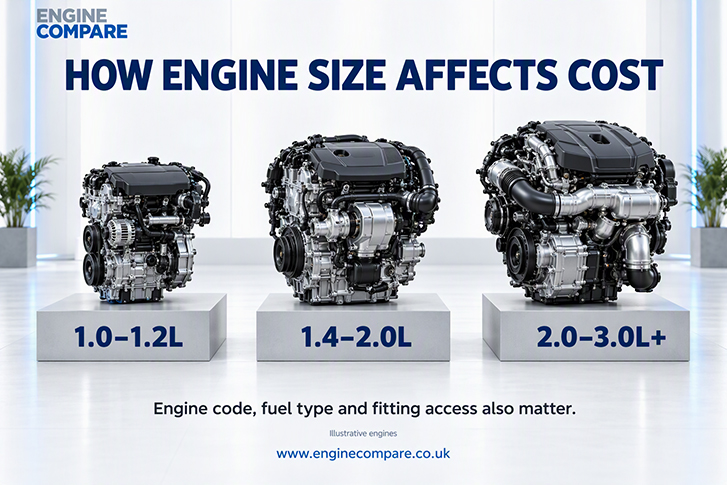
Engine size sets the baseline for your used car engine replacement cost, but four other factors move the number more: the engine code and its availability, whether the engine is petrol or diesel, how accessible it is in the engine bay, and whether the vehicle is a car or a commercial. A rare 1.6 diesel can cost more than a common 2.0, and a transverse four-cylinder can be cheaper to swap than a longitudinal six.
Petrol versus diesel at the same size
Diesel engine replacement costs are generally higher than petrol engine replacement costs at the same displacement, because diesel engines carry more complex components, weigh more and take longer to remove and refit. On a like-for-like basis, expect a diesel to sit 15–25% above its petrol equivalent in the same vehicle.
What increases the cost beyond the engine?
- Ancillaries: turbo, injectors, pumps and sensors transferred or renewed.
- Access: engines requiring subframe or front-end removal.
- Coding and adaptation on modern vehicles.
- Cooling system work required after a failure.
- Four-wheel-drive transmission interfaces.
How do you apply these ranges to your car?
Confirm the engine code, decide the route that matches your ownership plans, request three engine replacement quotes with identical scope, and compare the inclusions. When comparing used vs reconditioned engine costs, the size range tells you roughly where the job will land; the code and the scope tell you the actual number.
What does a small engine replacement look like in practice?
For a 1.0 or 1.2 petrol engine replacement in a supermini, the job is often a day’s labour with a unit that is plentiful in the used market. That combination puts total costs at the bottom of the market, and it is the reason replacing a small petrol engine is frequently cheaper than a major repair on a diesel.
What does a large diesel replacement look like?
For a 3.0 diesel engine replacement, expect significant dismantling, a heavier unit and additional work on cooling, EGR and turbo systems while access is available. Those factors put the job at the top of the range and explain why owners of large diesels weigh repair against replacement so carefully.
How does the vehicle type change the figure?
| Vehicle type | Multiplier on the base figure |
| Small hatchback | Baseline |
| Family saloon or crossover | +10–20% |
| SUV or large estate | +20–35% |
| Van or commercial | +20–40% |
| Four-wheel drive | +15–30% |
Those multipliers reflect labour and access rather than the engine itself, which is why the same engine can cost materially different amounts to replace in different vehicles.
What should the quote include at any size?
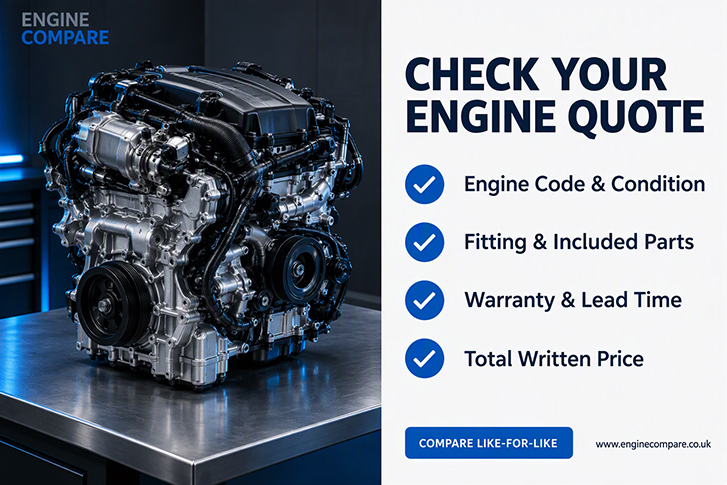
A recondition engine supply and fitting quote should include code confirmation, unit type, timing components, fluids, gaskets, coding, disposal, warranty terms and lead time. On larger engines, also confirm whether the cooling system and EGR components are assessed while access is available, because that work is far cheaper now than later.
Frequently asked questions
Does engine size determine replacement cost?
It sets the baseline, but the engine code, fuel type, accessibility and vehicle type often matter more.
Why is a diesel more expensive to replace than a petrol of the same size?
More complex components, greater weight and longer labour times.
Is a small petrol engine always cheaper to replace?
Usually, because units are plentiful and labour is straightforward. Rare small engines are the exception.
How much does labour contribute?
Typically 25–35% of the total on a mid-size engine, and more where major dismantling is required.
Should I compare by size or by code?
By code, always. Code determines availability, compatibility and the honest price for your car.
What is the one-line answer on cost by engine size?
Size sets the baseline, but your engine code, the fuel type and the vehicle it sits in decide the real figure.
What are the most common size-related surprises for owners?
Two. First, that a small petrol engine is often cheaper to replace than a mid-size diesel repair, which surprises owners who assume bigger means more expensive. Second, that accessibility matters as much as displacement: some compact cars are harder to work on than larger ones, and labour reflects that rather than the engine size.
How do you compare quotes across different sizes fairly?
To compare engine replacement quotes fairly, compare them within a size band and a fuel type, and always with the code confirmed. A 1.5 diesel quote and a 2.0 petrol quote are describing different jobs and putting them side by side produces a comparison that misleads rather than informs.
Which sizes surprise owners the most on cost?
The middle of the range, between 1.5 and 2.0 litres, is where most UK cars sit and where the variation is widest. Two 2.0 diesel engines of the same model year can differ by £1,000 fitted because of code availability, and owners comparing a quote for their car with a friend’s quote for a similar car are often comparing different engines entirely.
How do you use size ranges when your car is a commercial?
Van engine replacement costs and those for light commercials sit above the equivalent car figure because of access, duty cycle and weight. Add roughly 20–40% to the car figure for the same engine size and fuel, and check whether the job requires cab or front-end dismantling, which is often where the additional labour sits.
Does mileage affect the price of the replacement engine?
Mileage affects used engine prices directly, because lower-mileage engines command more, and it affects the likely total cost indirectly, because a high-mileage car usually needs more ancillary work while the engine is out. On a 150,000-mile vehicle, budget for injectors, cooling components and mounts as part of the same job.
Does engine size affect the warranty position?
Not directly, though larger engines usually carry higher-value warranties because the sums involved are greater. What matters more is the route: twelve months written on reconditioned and rebuilt units, thirty to ninety days on used. On a large diesel, the warranty is arguably worth more than on a small petrol, because the consequences of failure are more expensive.
What is the one-line answer on engine size and cost?
Size sets the baseline, but your engine code, the fuel type, the vehicle and the labour involved decide the figure you will be quoted.
