One of These Will Cost You Twice: Used vs Reconditioned Jaguar XJ Engines (The Hidden Trap Hook)
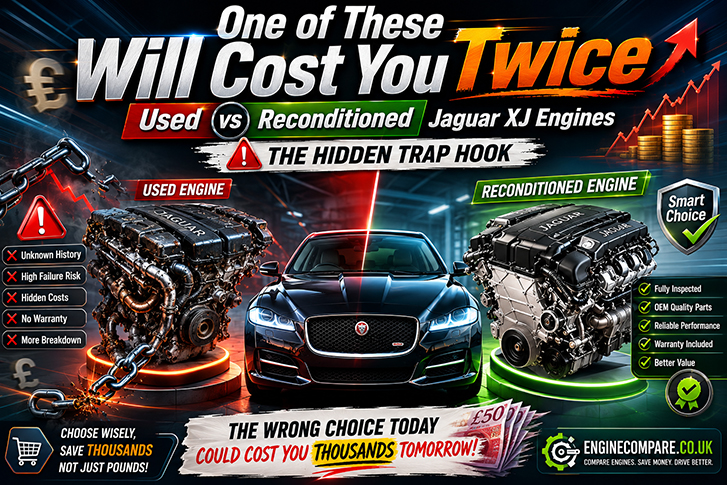
Stop Choosing Blind: The Ruthless Side-by-Side Breakdown No Engine Seller Wants You to See
QUICK ANSWER BOX
They look the same on paper – they’re not. A used Jaguar XJ Engine is a pulled, as-is unit with unknown internal wear, while a reconditioned Jaguar XJ Engine is stripped, machined, and fitted with new critical components to restore factory tolerances. One of these will cost you twice. Here’s which one: the cheap used engine will likely fail within 20,000 miles due to unaddressed timing chain or bore scoring issues, costing you a second engine plus £1,400+ in duplicated labour. For 90% of UK drivers keeping their XJ long-term, the reconditioned engine is the only mathematically sound choice.
COST SUMMARY BOX (Updated June 2026)
Before we dissect the engineering, we must anchor the financial reality. Budget suppliers want you to focus on the sticker price; we want you to focus on the total cost of ownership.
- Used Jaguar XJ 5.0L Engine: £1,200 – £1,800 (Supply only, 30-day warranty)
- Reconditioned Jaguar XJ 5.0L Engine: £2,800 – £3,900 (Supply only, 12–24-month warranty)
- The Hidden Liability (Worst-Case Failure): If your used engine fails, the removal, return shipping, and second fitting labour will cost you approximately £1,400+ before you even purchase a replacement.
Stop choosing blind. Here’s the real breakdown of what you actually get for your money.
What is the Actual difference Between a Used Jaguar XJ Engine and a Reconditioned Jaguar XJ Engine in a side-by-side Comparison?
A used Jaguar XJ Engine is a pulled unit sold strictly as-is with zero internal refurbishment, whereas a reconditioned Jaguar XJ Engine is stripped, cleaned, and fitted with new critical components to restore factory tolerances. The false equivalence trap assumes both are simply “replacement engines,” but their engineering realities dictate entirely different failure rates.
When budget suppliers use identical keyword terms to sell both, they exploit your inability to distinguish quality without professional knowledge. Side-by-side: what you actually get for your money is revealed below.
| Factor | Used Jaguar XJ Engine | Reconditioned Jaguar XJ Engine | Best For |
| Components Replaced | None (sold exactly as-pulled) | Timing chains, tensioners, bearings, seals, gaskets | Reconditioned (Guaranteed internal reliability) |
| Testing Process | Basic compression checks only | Dyno tested, leak-down tested, oil pressure tested | Reconditioned (Validated performance) |
| Warranty Depth | 30 days (often voided by install) | 12 to 24 months (comprehensive national coverage) | Reconditioned (Long-term financial protection) |
| Mileage Range | Unknown history (typically 60k-100k+) | Reset to zero on all replaced internal components | Reconditioned (Predictable lifespan) |
| Price (fluid GBP) | £1,200 – £1,800 | £2,800 – £3,900 | Used (Strictly for immediate, short-term cash flow) |
| Failure Risk | High (timing chain/bore scoring likely) | Low (mitigated by proactive parts replacement) | Reconditioned (Total peace of mind) |
| ULEZ Potential | Passes if original Euro 5/6 spec intact | Passes (retains original emissions hardware spec) | Tie (Both pass if fully compliant) |
| CRA 2015 Coverage | Weak (sold as seen/merchantable quality) | Strong (legally must be of satisfactory quality) | Reconditioned (Robust legal backing) |
Fitting a used engine without replacing the timing chain guides on the 5.0L AJ-V8 guarantees a repeat failure within 15,000 miles, turning your initial “bargain” into a £3,000 bill.
Why is There A £2,000 Reconditioned Engine Cost Gap Between Used and Rebuilt Options and Which Side of it are you on?
The reconditioned engine cost premium exists because premium rebuilders replace known failure points like the 5.0L AJ133 timing chain tensioners and cylinder liners, whereas budget suppliers simply steam-clean a used engine and slap a new sticker on it. You are paying for the elimination of catastrophic internal faults, not just the physical block.
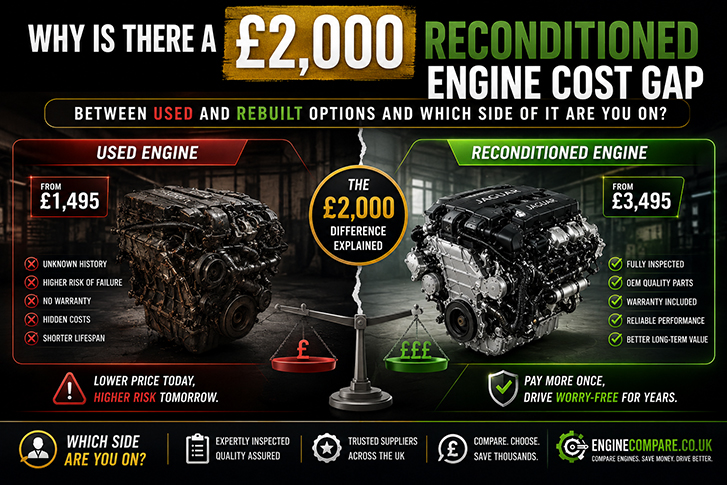
Budget suppliers position their inferior, washed stock as equivalent to premium rebuilds to protect their margins. They rely on the fact that you cannot see inside the block. When you anchor the initial £1,500 saving against the £1,400+ cost of a second fitting if the used unit fails, the financial exploitation becomes obvious. You are either paying for engineering certainty upfront, or you are paying for it in duplicated labour later.
A £1,500 “reconditioned” 5.0L engine from a budget breaker is almost certainly just a washed used engine, as the actual machine work and new OEM parts required for a true recondition exceed £1,800 in raw costs alone.
How Many Miles Can You Realistically Expect from A Used Jaguar XJ Engine Versus a Remanufactured Engine on UK Roads?
On UK roads, a standard used Jaguar Engine will realistically deliver between 20,000 and 40,000 miles before a major ancillary or internal fault emerges, while a properly remanufactured engine will reliably cover 80,000 to 100,000+ miles. The 5.0L V8’s lifespan is entirely dictated by the condition of its Nikasil-lined bores and timing gear at the point of installation.
For most UK drivers covering 10,000 miles per year on mixed A-road and motorway routes, the reconditioned engine wins because it resets the clock on the timing chain and water pump, which are the primary mileage killers on the AJ-V8. If you only plan to keep the car for 12 months to sell it on, the used engine might suffice, but for long-term ownership, the remanufactured route is the only logical conclusion.
Short, cold-start UK town driving kills the 5.0L supercharged variants via fuel dilution in the oil, meaning a high-mileage used engine from a city car is a ticking time bomb compared to one from a motorway cruiser.
What Does UK Law Actually Protect When You Choose a Reconditioned Jaguar XJ Engine Versus a Used Engine and Where Does the Cover Stop?
Under the Consumer Rights Act 2015, a reconditioned Jaguar XJ Engine is legally required to be of “satisfactory quality” and fit for purpose for a reasonable duration (typically 12+ months), whereas a used engine is often sold with “as seen” caveats that severely limit your statutory rights after 30 days. The legal divide hinges on whether the supplier has actively restored the engine or merely resold it.
When you buy a reconditioned Jaguar XJ 5.0 engine from a reputable supplier, the CRA 2015 mandates that the engine must last. If it fails at month 11, the burden of proof is on the supplier to prove you caused it. With a used engine, after the initial 30-day right to reject, you are left fighting an uphill battle to prove the fault was inherent at the time of sale. Beware of warranty small print that excludes “consequential loss” or “labour costs”—these are designed to leave you paying the garage bill even if the engine is replaced for free.
If your garage fails to program the ECU with the new engine’s VIN or update the immobilizer correctly, the engine supplier will void your warranty claiming “electrical damage,” leaving you with zero Consumer Rights Act 2015 protection.
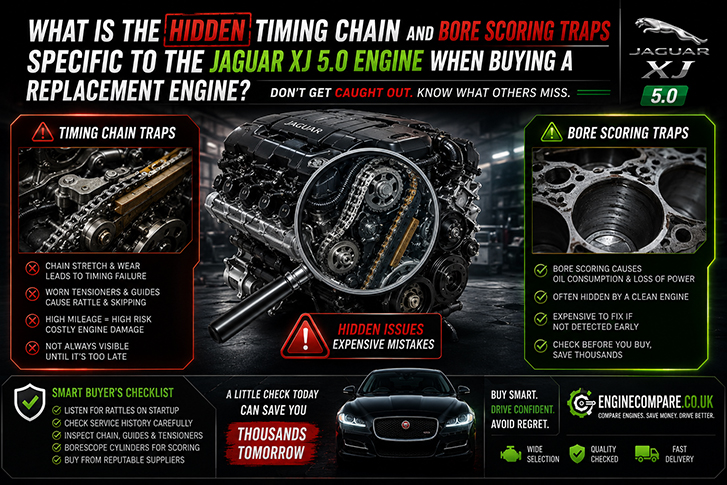
What Is the Hidden Timing Chain and Bore Scoring Traps Specific to the Jaguar XJ 5.0 Engine When Buying a Replacement Engine?
The Jaguar XJ 5.0 Engine (specifically the AJ-V8 and AJ133 codes) is notoriously susceptible to timing chain guide fragmentation and cylinder bore scoring, meaning any replacement engine that hasn’t specifically addressed these two areas is a massive financial risk. The early 5.0L NA and Supercharged variants suffer from plastic tensioner failure, while the direct-injection models risk bore wash scoring from cold starts.
When mapping the entity chain—Engine Code (AJ133) to Chassis Code (X351) to Ancillary Variant (ZF 8HP gearbox mating)—you realise that the 5.0L is not a simple swap. The supercharger couplers rattle and fail, and the high-pressure fuel pumps (HPFP) wear out. A true reconditioning process addresses these specific technical bulletins; a used engine simply passes the original owner’s problems onto you.
Will A Used or Reconditioned Jaguar XJ Engine Pass UK ULEZ, MOT Emissions and Retain Its VED Band?
Both a used Jaguar XJ Engine and a reconditioned Jaguar XJ Engine will pass ULEZ and retain their VED band provided the replacement is an exact like-for-like engine code match with all original emissions equipment refitted. However, a poorly reconditioned engine with leaking valve stem seals or worn catalytic converters will fail the MOT emissions test, whereas a quality rebuild replaces these consumables.
ULEZ compliance is strictly tied to the vehicle’s recorded Euro status, but the physical reality relies on the engine burning cleanly. If a used engine is burning oil due to worn piston rings, it will destroy the catalytic converters, leading to an MOT failure and potentially triggering the ULEZ penalty if the ECU throws emissions-related fault codes. A properly reconditioned engine ensures the internal seals and rings are new, protecting the expensive emissions hardware downstream.
Explore More
- It is Jaguar XF, hop in to Fly on Roads
- Jaguar XF, the Most Reliable, Comfortable and Powerful Car by Jaguar
- From Front to Back, Top to Bottom, Jaguar S-Type Is Nothing Less Than a Masterpiece
- Jaguar’s Bargain Chip – The XE Saloon
- Is Jaguar’s New 2016 SUV Really an SUV?
People Also Ask (FAQ)
1. Is a reconditioned Jaguar XJ Engine better than a used one?
Yes, a reconditioned Jaguar XJ Engine is significantly better because its internal wear components are replaced with new OEM parts, resetting its lifespan. A used engine is sold as-is, meaning you inherit the previous owner’s mechanical wear and impending failures.
2. How much does a replacement 5.0L Jaguar XJ engine cost in the UK?
A replacement 5.0L Jaguar XJ engine typically costs between £1,200 and £1,800 for a used unit, and £2,800 to £3,900 for a fully reconditioned unit. These prices are for the supply only and exclude VAT and fitting labour.
3. What causes the timing chain to fail on the Jaguar 5.0L AJ-V8 engine?
The timing chain fails on the 5.0L AJ-V8 engine primarily due to the degradation of the plastic timing chain guides and the wear of the hydraulic tensioners, which causes the chain to slacken and jump. This is exacerbated by extended oil service intervals and cold-start wear on the Nikasil-lined cylinder bores.
4. Can I put a supercharged AJ133 engine in a naturally aspirated Jaguar XJ?
You cannot simply drop a supercharged AJ133 engine into a naturally aspirated Jaguar XJ without extensive modifications. It requires swapping the ECU, wiring harness, fuel pump, cooling system, and exhaust manifolds to accommodate the forced induction hardware and different compression ratios.
5. Does a reconditioned engine come with a new ECU and immobilizer match?
No, a reconditioned engine is supplied as a mechanical long block or complete unit and does not include a new ECU. You must retain your original ECU and have your installer program the immobilizer and VIN details to match the new engine hardware.
Stop gambling with your Jaguar’s heart.
You now possess the rare, transparent data the market actively suppresses. You know the exact engineering, financial, and legal divides between a liability and an asset. Do not let a budget supplier trap you in the false equivalence of identical keywords. Secure your Jaguar’s XJ future with a unit built to outlast the warranty.
